

COCOBOD’s statutory monopoly/criminalised single-buyer gadget (Part I) – Life Pulse Daily
 Editor-in-chiefFebruary 23, 20263 Mins read10
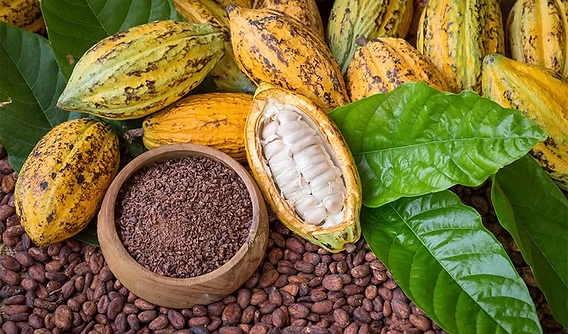
COCOBOD’s Statutory Monopoly: A Constitutional Analysis of Ghana’s Single-Buyer Cocoa System
Introduction: The Constitutional Tension at the Heart of Ghana’s Cocoa Sector
Ghana’s global reputation as a premium cocoa producer is built on the labor of over 800,000 smallholder farmers. Yet, these farmers operate within a unique and highly regulated legal framework that dictates every aspect of their commercial activity: to whom they can sell, at what price, and under what conditions. At the center of this framework is the Ghana Cocoa Board (COCOBOD), a state-controlled entity endowed by law with a statutory monopoly over the domestic purchasing and export of cocoa. This system, established by the Ghana Cocoa Board Act of 1984 (PNDCL 81), criminalizes any transaction outside of COCOBOD’s authorized channels, imposing severe penalties including mandatory imprisonment.
This article presents a rigorous, first-principles legal analysis of this single-buyer system. We will examine whether the compulsory transfer of a farmer’s property—their cocoa beans—to a state-designated buyer, at a state-determined price, constitutes a permissible regulation of commerce or an unconstitutional deprivation of property rights under Article 20 of Ghana’s 1992 Constitution. The analysis moves beyond economic policy debates to focus on fundamental legal principles: the nature of property rights, the state’s power of compulsory acquisition, and the constitutional requirement that any infringement on rights must be reasonably justifiable in a democratic society. By dissecting the statutory mechanism and its practical effects, we aim to provide a clear, pedagogical understanding of one of Ghana’s most enduring and controversial agricultural policies.
Key Points: The Core Legal Arguments
- Constitutional Property Scope: Article 20 of Ghana’s Constitution protects not just physical “property” but any “interest in or right over any property,” encompassing the full “bundle of rights” including the right to possess, use, enjoy, and dispose of an asset.
- Cocoa as Farmer Property: Cocoa beans harvested by a farmer are unequivocally their personal property. The statutory monopoly directly interferes with the core incident of ownership: the right to freely dispose of one’s property.
- Statutory Mechanism of Compulsion: The Ghana Cocoa Board Act (PNDCL 81) legally compels farmers to sell exclusively to COCOBOD or its agents, fixes the farm-gate price unilaterally, and criminalizes any independent sale or export, with penalties of 5-10 years imprisonment.
- Effect as De Facto Acquisition: The practical effect of the law is to force a transfer of private property to a state-controlled entity. This resembles a compulsory acquisition or requisition, triggering the constitutional safeguards of Article 20(1).
- Public Interest & Necessity Test: Any state restriction on property rights must be demonstrably necessary for a defined public purpose (e.g., public order, national economic stability) and must be the least restrictive means available. The article questions whether a total monopoly meets this “necessity” test or if less restrictive alternatives (e.g., regulated multi-buyer systems, price floors) could achieve the same state objectives.
- Extinguishment of Ownership Incidents: By eliminating the farmer’s freedom to choose a buyer, negotiate price, or access export markets, the state effectively extinguishes fundamental attributes of ownership protected by the Constitution.
- Constitutional Supremacy: If the statutory scheme is found to be an unconstitutional deprivation of property without proper justification and safeguards, its provisions are liable to be invalidated by the courts, as the Constitution is the supreme law of Ghana.
Background: The Architecture of Ghana’s Cocoa Monopoly
Historical Context and the Role of COCOBOD
To understand the present legal structure, one must look to history. Ghana’s cocoa sector was historically dominated by private merchants and foreign trading companies. In the mid-20th century, following periods of price volatility and concerns about farmer exploitation, the state progressively increased its control. The modern framework was solidified after the 1983 Economic Recovery Programme, with the enactment of PNDCL 81 in 1984. This law reconstituted the Ghana Cocoa Board (established earlier in 1947) as the central, state-controlled authority with exclusive legal authority over the cocoa economy.
COCOBOD’s stated mandates include: stabilizing farmers’ incomes through fixed prices, ensuring quality control, facilitating export logistics, and securing foreign exchange earnings for the national treasury. It operates through a network of purchasing clerks and licensed buying companies (LBCs), which are typically wholly-owned subsidiaries or entities under its strict control. The state itself is the de facto brand; cocoa is exported as “Ghana Cocoa,” with all international contracts and reputational risk managed by COCOBOD.
The Legal Framework: Ghana Cocoa Board Act, 1984 (PNDCL 81)
The Act is the statutory cornerstone of the monopoly. Its key provisions create a tightly closed system:
- Exclusive Purchasing Authority (Section 3): Empowers COCOBOD to fix the producer price (with ministerial approval) and designates it as the sole authorized buyer. It prohibits any person from buying cocoa except from COCOBOD or its authorized agents.
- Criminalization of Independent Trade (Sections 4(1), 4(6), 4(7)): It is a criminal offense for:
- Any person to buy cocoa otherwise than in accordance with the Act.
- Any producer (farmer) to sell cocoa to an unauthorized person.
- Any person to export cocoa without COCOBOD’s written


Leave a comment