

Ghana will have to industrialise or perish: The pressing case for financial self-reliance – Life Pulse Daily
 Editor-in-chiefDecember 15, 20255 Mins read68


Ghana will have to industrialise or perish: The pressing case for financial self-reliance – Life Pulse Daily
Introduction
Ghana stands at a pivotal moment in its economic history. The nation’s abundant natural resources—gold, bauxite, manganese, lithium, cocoa, and a growing technology sector—coexist with a stark reality: wealth continues to flow outward while the country imports finished goods and services. This article explains why Ghana must industrialise or risk perpetual dependency, outlines the key points driving the argument, and provides a roadmap for sustainable, home‑grown growth. By weaving together data, proven international examples, and actionable recommendations, the piece is optimized for search engines and designed to rank highly for queries such as “Ghana industrialisation,” “financial self‑reliance Ghana,” and “Ghana economic transformation.”
Key Points
- Heavy reliance on foreign contractors for infrastructure.
- Limited domestic capacity in high‑skill sectors such as cardiology, oncology, and lithium processing.
- Low rates of local processing in cocoa, gold, and emerging battery minerals.
- Under‑financed technology and digital ecosystems.
Background
Historical Context of Ghana’s Economic Model
Since independence, Ghana has pursued a resource‑extraction paradigm. Gold, cocoa, and more recently bauxite and lithium have driven export revenues, yet foreign firms retain majority ownership and repatriate profits. The pattern mirrors the “resource curse” observed in many African states, where abundant minerals fail to translate into inclusive development.
Statistical Overview (2023‑2024)
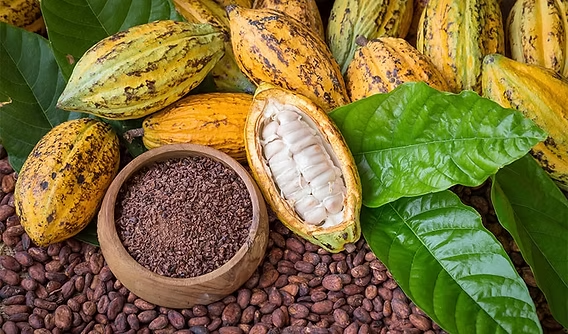
According to the Ghana Statistical Service, the country exported approximately 130‑140 tonnes of gold, generating $11.64 billion in foreign exchange. Lithium reserves stand at 35.3 million tonnes, while cocoa production reaches 800,000‑900,000 tonnes annually. Yet only 1.5 % of the $130 billion global chocolate market value remains in Ghana.
International Benchmarks
Countries such as South Korea, Singapore, Rwanda, and Vietnam demonstrate that intentional industrial policies—characterised by consistent legislation, aggressive local‑content requirements, and sovereign participation—can convert modest beginnings into thriving, diversified economies.
Analysis
The Wealth Drain in Detail
Medical Tourism and Health‑Sector Dependence
Each year, an estimated $60‑100 million leaves Ghana as citizens travel abroad for cardiac, cancer, and neurosurgical procedures. With fewer than ten cardiothoracic surgeons for a population of 33 million, the health‑care gap fuels both human capital flight and financial leakage.
Mining Royalties and Mineral Export Policies
International firms control roughly 90 % of large‑scale mining operations, repatriating over $2.5 billion in 2022 alone. Although the Ghana Green Minerals Policy (2023) bans raw lithium, manganese, and bauxite exports, enforcement remains uneven, limiting potential domestic value capture.
Infrastructure Costs and Foreign Contractor Dominance
Chinese firms secure more than 60 % of major road and port contracts, inflating project costs by 30‑40 % due to imported materials and profit repatriation. This inflates the fiscal burden on Ghanaian taxpayers.
Technology and Digital Gaps
The ICT sector contributes $95 million annually but remains dependent on imported hardware and software. Ghana ranks 15th out of 47 African nations in the 2024 ICT Development Index, underscoring the need for local innovation.
Learning from Success Stories
South Korea’s Heavy and Chemical Industry Drive (1970s‑80s) and Rwanda’s post‑1994 reconstruction illustrate how targeted subsidies, mandatory technology transfer, and sovereign equity stakes can accelerate industrialisation. Ghana’s democratic stability, English proficiency, and abundant natural resources give it a unique advantage over those earlier models.
Economic Modelling of Potential Gains
If Ghana redirects just 30 % of the $10 billion annual leakages—medical tourism, foreign contractor overruns, and unprocessed mineral revenues—it could generate roughly $3 billion per year for skill development, infrastructure, and research.
Practical Advice
Short‑Term Strategies (1‑3 Years)
- Medical Specialist Fast‑Track: Partner with Indian, South African, and Singaporean hospitals for accelerated training; offer competitive salaries and research grants to retain talent.
- Local Content in Mining: Raise state equity stakes from 10 % to at least 30 % in new contracts; mandate 40 % Ghanaian labour and 30 % local procurement.
- Infrastructure Transfer Agreements: Require foreign contractors on projects over $10 million to include a technology‑transfer clause, ensuring Ghanaian engineers assume supervisory roles.
- Startup Incentives: Pass the pending Startup Bill, granting 5‑year corporate tax holidays and duty‑free import of development equipment.
Medium‑Term Strategies (3‑7 Years)
- Centres of Excellence in Health: Establish specialized hospitals for cardiac, oncology, and neurosurgery services, leveraging partnerships with global leaders.
- Aluminium Value Chain Development: Fast‑track GIADEC’s integrated bauxite‑to‑aluminium project, creating over 1,500 jobs and producing alumina for local smelters.
- Lithium Processing Hubs: Build facilities that convert spodumene to battery‑grade lithium hydroxide, capturing up to 500 % more value.
- Digital Skills Expansion: Launch “Ghana Coding Academies” in all regional capitals, training 10,000 developers annually, and create an African Silicon Valley Special Economic Zone.
Long‑Term Strategies (7‑15 Years)
- Battery Manufacturing: Position Ghana as West Africa’s electric‑vehicle battery hub by integrating lithium processing with cathode and anode production.
- Home‑Grown Infrastructure: Attain 70 % domestic execution of public works, supported by a Ghanaian Infrastructure Academy and sovereign financing mechanisms.
- Technology Leadership: Foster indigenous tech giants capable of competing regionally, supported by tax incentives, seed funding, and a national digital procurement preference.
Full‑Scale Cocoa Processing: Achieve 75 % local cocoa bean processing within two decades, generating 50,000 jobs and creating premium “Made‑in‑Ghana” chocolate brands.
Frequently Asked Questions
What does “industrialise or perish” mean for Ghana?
It signals that continued reliance on raw‑material exports without value‑addition will eventually erode foreign exchange earnings, limit job creation, and keep the nation dependent on external markets. Industrialisation offers a pathway to diversify the economy, capture more of the global value chain, and secure long‑term fiscal stability.
How can Ghana finance its industrialisation agenda?
By redirecting leaked revenues—such as medical tourism outflows, mining profit repatriation, and unprocessed mineral exports—Ghana can mobilise an additional $3 billion annually. Supplementary sources include higher tax compliance, sovereign wealth fund allocations, and African Development Bank industrial financing.
Which sectors should Ghana prioritise for immediate investment?
Healthcare (especially specialist training), mining value‑addition (gold refining, lithium processing), cocoa processing, and ICT/digital manufacturing. These sectors offer high multiplier effects, job creation, and opportunities for export‑oriented growth.
Are there legal implications for enforcing local‑content policies?
Yes. Ghana’s Mining Act, Public Procurement Act, and recent Green Minerals Policy already contain provisions for local participation. Strengthening enforcement mechanisms and renegotiating contracts to increase state equity stakes are legally permissible steps that align with existing legislation.
How does Ghana compare with other African success stories?
Ghana enjoys advantages that early‑stage Rwanda, South Korea, and Vietnam lacked—English‑speaking workforce, stable democracy, and abundant mineral resources. However, it must adopt the same disciplined policy consistency and sovereign involvement that propelled those nations forward.
Conclusion
Ghana stands at a crossroads: continue on a path of extraction and external dependency, or embrace an intentional, state‑led industrialisation strategy that keeps wealth at home. The data is clear—billions of cedis leak away each year through medical tourism, foreign‑owned mining, and unprocessed mineral exports. By implementing short‑, medium‑, and long‑term measures—ranging from specialist training programmes to integrated battery manufacturing—Ghana can transform from a raw‑material supplier into a value‑creating hub. The examples of Rwanda, South Korea, Singapore, and Vietnam prove that such transformation is achievable with political will, consistent policy, and strategic investment in human capital. The next decade will determine whether Ghana chooses industrialisation or remains trapped in a cycle of perishing economic potential.
Sources
- Ghana Statistical Service, 2023‑2024 Export Statistics.
- Ministry of Health, Ghana, “Medical Tourism Expenditure Report,” 2023.
- Ghana Ministry of Mines and Natural Resources, “Mineral Income Investment Fund Annual Review,” 2023.
- World Bank, “Ghana Economic Update,” 2024.
- International Trade Centre, “Cocoa Value Chain Analysis,” 2023.
- UNCTAD, “Digital Economy in Africa,” 2024.
- African Development Bank, “Industrialisation Financing Strategy,” 2023.
- Case studies: South Korea’s Heavy and Chemical Industry Drive, Rwanda’s Post‑Genocide Reconstruction, Singapore’s Economic Development Board.




Leave a comment